↑
  • HAL Typefaces
  • Collection
  • Licensing
  • Notes
  • About
  • Trial Fonts
  • Collection
  • Licensing
  • Notes
  • About
  • Trial Fonts
  • Colant
  • Display
  • Text
  • Features
  • Glyphs
  • Info
  • In Use

Overview

Colant Display
Regular
Colant Text
Regular
Regular Italic

Display

Size
 
Features
Acid House
Size
 
Features
The Ⅳ Genre Michigan Lakers 15.8.1973†
Size
 
Features
Lyric Opera Public Jazz Soul & Hip-hop* $2.50 Mount “Portage” Riverside Cold Wind in the City

Text

Size
 
Features
Jack Trax
Size
 
Features
Local Megamix ❺Chicago G’s Phat 1/2 Recordz
Size
 
Features
London’s club Shoom opened in November 1987 and was one of the first clubs to introduce acid house to the clubbing public of the UK. It was opened by Danny Rampling and his wife, Jenny. The club was extremely exclusive and featured thick fog, a dreamy atmosphere and acid house. This period began what some call the Second Summer of Love, a movement credited with a reduction in football hooliganism: instead of fights, football fans were listening to music, taking ecstasy, and joining the other club attendees in a peaceful movement that has been compared to the Summer of Love in San Francisco in 1967. Another club called Trip was opened in June 1988 by Nicky Holloway at the Astoria in London’s West End. Trip was geared directly towards the acid house music scene. It was known for its intensity and stayed open until 3 AM. The patrons would spill into the streets chanting and drew the police on regular occasions. The reputation that occurrences like this created along with the UK’s strong anti-club laws started to make it increasingly difficult to offer events in the conventional club atmosphere. Considered illegal in London during the late ’80s, after-hour clubbing was against the law. However, this did not stop the club-goers from continuing after-hours dancing. Police raided the after-hour parties, so the groups began to assemble inside warehouses and other inconspicuous venues in secret, hence also marking the first developments of the rave. Raves were well attended at this time and consisted of single events or moving series of parties thrown by production companies or unlicensed clubs. Two well-known groups at this point were Sunrise, who held particularly massive outdoor events, and Revolution in Progress (RIP), known for the dark atmosphere and hard music at events which were usually thrown in warehouses or at Clink Street, a South East London nightclub housed in a former jail. Promoters like (The Big Lad) Shane McKenzie and the gang back in 1987 were doing small parties in NW London, moving raves from the streets and the fields to the clubs of London 1990–2005 which saw the future of raves in clubs all over the UK and Spain. Once the term acid house became more widely used, participants at acid house-themed events in the UK and Ibiza made the psychedelic drug connotations a reality by using club drugs such as ecstasy and LSD. The association of acid house, MDMA, and smiley faces was observed in New York City by late 1988. This coincided with an increasing level of scrutiny and sensationalism in the mainstream press, although conflicting accounts about the degree of connection between acid house music and drugs continued to surface.
Size
 
Features
Kraftwerk
Size
 
Features
Frankie Knuckles Planet Rock?! R&B; Italo-Disco
Size
 
Features
In the late 1980s and early 1990s, British news media and tabloids devoted an increasing amount of coverage to the hedonistic acid house/rave scene, focusing increasingly on its association with psychedelic drugs and club drugs. At first, promoters like Tony Colston-Hayter tried to monetize the scene by promoting his Apocalypse Now parties (organised with Roger Goodman) on the ITV News (ITN) in the same way that a latter-day popstar such as Gary Barlow would promote his album on the news (generally in the “And Finally” part of the programme). However, these reports soon changed from positive promotion to a negative viewpoint, with the sensationalist nature of the coverage contributing to the banning of acid house during its heyday from radio, television, and retail outlets in the United Kingdom. The moral panic of the press began in late 1988, when a UK red-top tabloid called The Sun, which only days earlier on October 12 had promoted acid house as cool and groovy while running an offer on acid smiley face t-shirts, abruptly turned on the scene. On October 19, The Sun ran with the headline “Evils of Ecstasy”, linking the acid house scene with the newly popular and relatively unknown drug. The resultant panic incited by the tabloids eventually led to a crackdown on clubs and venues that played acid house and had a profound negative impact on the scene. Any records that mentioned the word acid, such as Dancin’ Danny D’s record with scene promoter Gary Haisman (D Mob’s “We Call It Acieed”), were taken off radio and television playlists just as they were climbing towards the top of the UK chart. By the time Colston-Hayter had invited another ITV news team down to promote his latest party (this time from Granada’s current affairs show World in Action), acid house was being described as a sinister and evil cult that was just encouraging people to take drugs. Despite this, one tune broke through into the mainstream in November 1988. Stakker Humanoid, produced by Brian Dougans (later of Future Sound of London), was a hit not just at influential clubs like The Haçienda in Manchester or Shoom in London, but was championed by mainstream stalwarts such as BBC Radio DJ Bruno Brookes and record producer, Pete Waterman. It went on to reach number 17 in the UK in November 1988, leading to Dougans’ appearance on Top of the Pops on December 1, 1988.

Features

Glyphs

▼Basic Characters
▼Punctuation
▼Oldstyle and Tabular Figures
▼Roman and Circled Figures
▼Ligatures
▼Language Extension
▼Fractions and Ordinals
▼Superscript and Subscript
▼Currency and Math
▼Arrows and Symbols

Info

Description

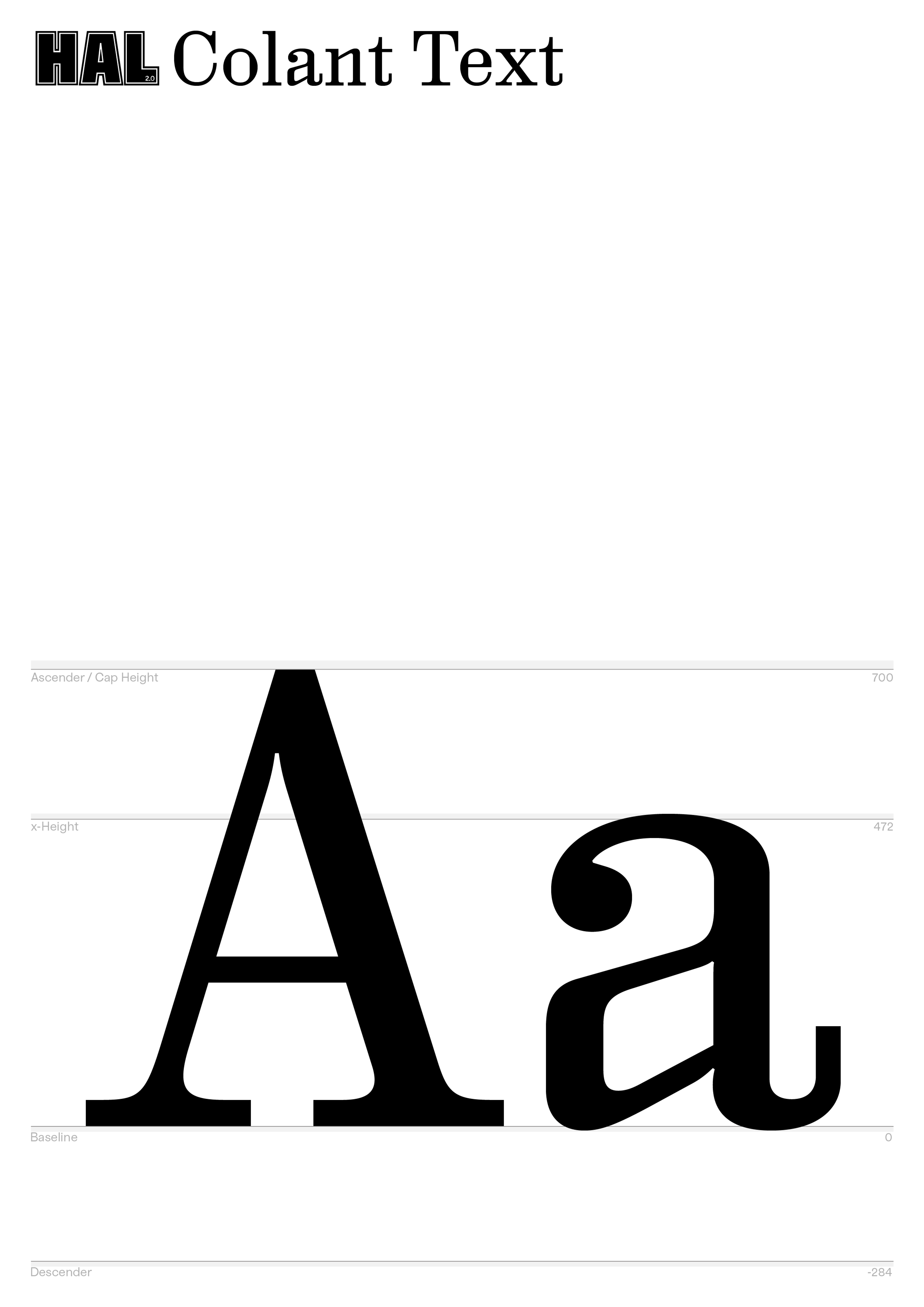
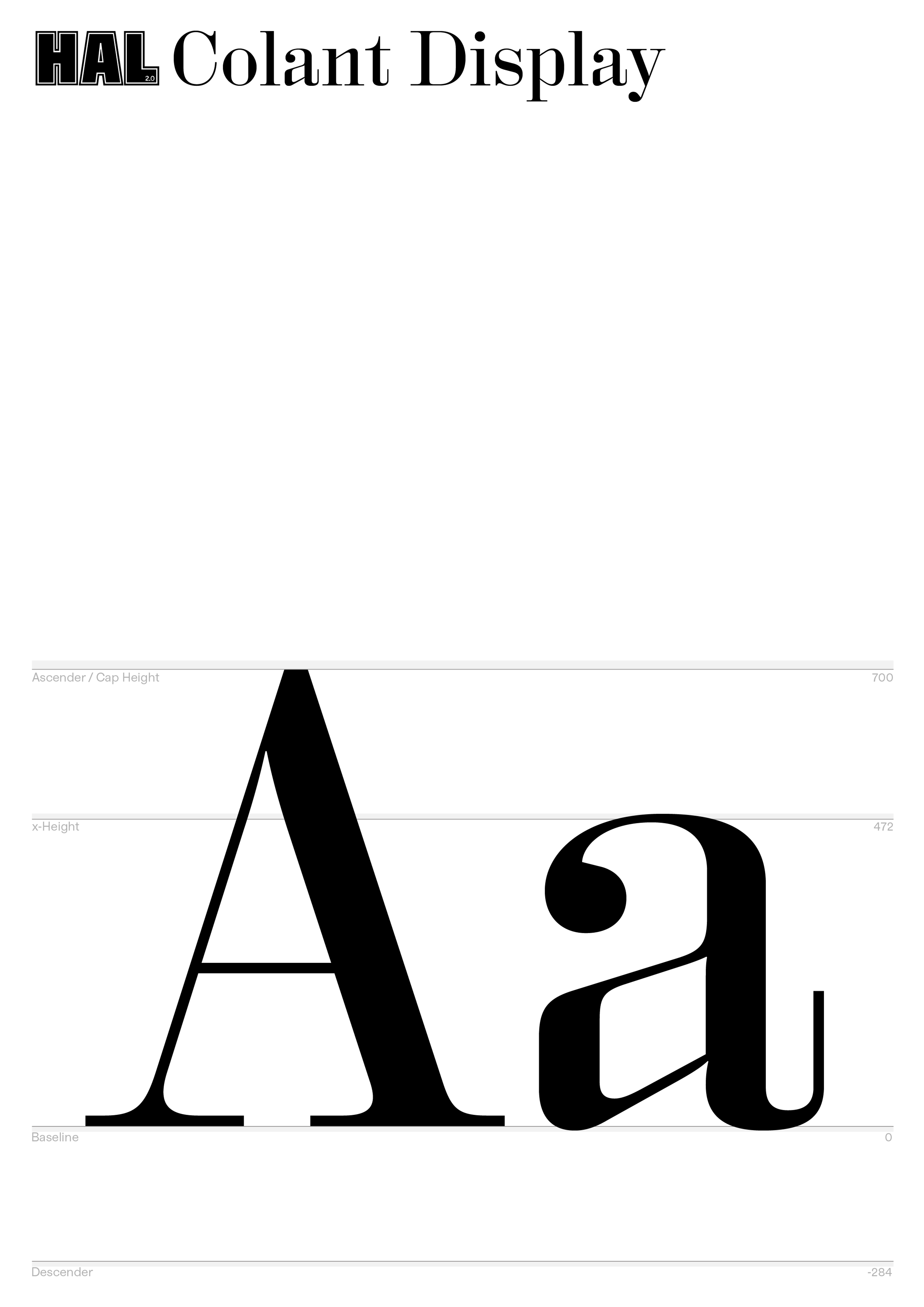
HAL Colant is based on Columbia Antiqua, a Scotch/Modern-style serif typeface, featuring distinct angular details; originally produced by the Bauer’sche Giesserei (Frankfurt am Main) on the occasion of the 1893 World Exposition in Chicago, Illinois. Colant Display, ideal for headlines at larger sizes, is more closely oriented to the original source, while Text Regular and Italic are extended styles with less contrast, optimised for typesetting body texts at smaller sizes.

Credits

Design: HAL Typefaces
Production: HAL Typefaces
Volume: 2 families, 3 styles
File Formats: otf, ttf, woff, woff2
Release Year: 2020 (updated 2023)
Spacing/Kerning: Igino Marini

Supported Languages

Acheron, Achinese, Acholi, Achuar-Shiwiar, Afar, Afrikaans, Aguaruna, Alekano, Aleut, Alonquin, Amahuaca, Amarakaeri, Amis, Anaang, Andaandi, Dongolawi, Anuta, Aragonese, Arbëreshë Albanian, Asháninka, Ashéninka Perené, Asturian, Atayal, Balinese, Balkan Romani, Banjar, Bari, Basque, Batak Dairi, Batak Karo, Batak Mandailing, Batak Simalungun, Batak Toba, Bemba (Zambia), Bena (Tanzania), Bikol, Bini, Bislama, Borana-Arsi-Guji Oromo, Bosnian, Breton, Buginese, Candoshi-Shapra, Caquinte, Caribbean Hindustani, Cashibo-Cacataibo, Cashinahua, Catalan, Cebuano, Central Aymara, Central Kurdish, Central Nahuatl, Chachi, Chamorro, Chavacano, Chiga, Chiltepec Chinantec, Chokwe, Chuukese, Cimbrian, Cofán, Cook Islands Māori, Cornish, Corsican, Creek, Crimean Tatar, Croatian, Czech, Danish, Dehu, Dimli, Dutch, Eastern Arrernte, Eastern Oromo, Efik, English, Faroese, Fijian, Filipino, Finnish, French, Friulian, Gagauz, Galician, Ganda, Garifuna, German, Gheg Albanian, Gilbertese, Gooniyandi, Gourmanchéma, Guadeloupean Creole French, Gusii, Haitian, Hani, Hiligaynon, Hopi, Huastec, Hungarian, Hän, Icelandic, Igbo, Iloko, Inari Sami, Indonesian, Irish, Istro Romanian, Italian, Ixcatlán Mazatec, Jamaican Creole English, Javanese, Jola-Fonyi, K’iche’, Kabuverdianu, Kaingang, Kala Lagaw Ya, Kalaallisut, Kalenjin, Kamba (Kenya), Kaonde, Kara-Kalpak, Karelian, Kashubian, Kekchí, Kenzi, Mattokki, Khasi, Kikuyu, Kimbundu, Kinyarwanda, Kirmanjki, Kituba (DRC), Kongo, Konzo, Kven Finnish, Kölsch, Ladin, Ladino, Latgalian, Lithuanian, Lombard, Low German, Lower Sorbian, Luba-Lulua, Lule Sami, Luo (Kenya and Tanzania), Luxembourgish, Macedo-Romanian, Madurese, Makonde, Malagasy, Malaysian, Maltese, Mam, Mandinka, Mandjak, Mankanya, Manx, Maore Comorian, Maori, Mapudungun, Marshallese, Matsés, Mauritian Creole, Meriam Mir, Meru, Minangkabau, Mirandese, Mizo, Mohawk, Montenegrin, Munsee, Murrinh-Patha, Mwani, Mískito, Naga Pidgin, Ndonga, Neapolitan, Ngazidja Comorian, Niuean, Nobiin, Nomatsiguenga, North Ndebele, Northern Kurdish, Northern Qiandong Miao, Northern Sami, Northern Uzbek, Norwegian, Nyanja, Nyankole, Occitan, Ojitlán Chinantec, Orma, Oroqen, Palauan, Pampanga, Papantla Totonac, Papiamento, Pedi, Picard, Pichis Ashéninka, Piemontese, Pijin, Pintupi-Luritja, Pipil, Pohnpeian, Polish, Portuguese, Potawatomi, Purepecha, Páez, Quechua, Romanian, Romansh, Rotokas, Rundi, Samoan, Sango, Sangu (Tanzania), Saramaccan, Sardinian, Scots, Scottish Gaelic, Sena, Seri, Seselwa Creole French, Shawnee, Shipibo-Conibo, Shona, Shuar, Sicilian, Silesian, Slovak, Slovenian, Soga, Somali, Soninke, South Ndebele, Southern Aymara, Southern Qiandong Miao, Southern Sami, Southern Sotho, Spanish, Sranan Tongo, Standard Estonian, Standard Latvian, Standard Malay, Sundanese, Swahili, Swedish, Swiss German, Tagalog, Tahitian, Tedim Chin, Tetum, Tetun Dili, Toba, Tok Pisin, Tokelau, Tonga (Tonga Islands), Tonga (Zambia), Tosk Albanian, Tumbuka, Turkish, Turkmen, Tuvalu, Tzeltal, Tzotzil, Uab Meto, Umbundu, Ume Sami, Upper Guinea Crioulo, Upper Sorbian, Venetian, Veps, Vietnamese, Vlax Romani, Võro, Walloon, Walser, Waray (Philippines), Warlpiri, Wayuu, Welsh, West Central Oromo, Western Abnaki, Western Frisian, Wiradjuri, Wolof, Xhosa, Yanesha’, Yao, Yucateco, Zapotec, Zulu, Záparo
Typeface in use
PDF Specimen
Colant Display
Typeface in use
PDF Specimen
Colant Text

In Use

End of Year Exhibition, Umeå School of Architecture (UMA) Design by Studio Sirka, 2023

Yair Elazar Glotman, Speculative Memories Design by Cave Studio, 2022

Sign Up to the HAL Newsletter

Illustration
Four GroteskGapMagicMatexRepostTimezoneColantTwins
  • © 2026 HAL Typefaces
  • Newsletter
  • Cookies & Privacy