↑
  • HAL Typefaces
  • Collection
  • Licensing
  • Notes
  • About
  • Trial Fonts
  • Collection
  • Licensing
  • Notes
  • About
  • Trial Fonts
  • Four Grotesk
  • Standard
  • Variable
  • Features
  • Glyphs
  • Info
  • In Use

Overview

Thin Thin Italic Light Light Italic
Regular Regular Italic Book Book Italic
Medium Medium Italic
Bold Bold Italic Heavy Heavy Italic
Ultra Ultra Italic
Variable

Standard

Size
 
Features
Greatness
Size
 
Features
Intl. Federation of Horseracing Authorities Gambling—Betting
Size
 
Features
Flat racing is the most common form of horse racing seen worldwide. Flat racing tracks are typically oval in shape and are generally level, although in Great Britain and Ireland there is much greater variation, including figure-of-eight tracks like Windsor and tracks with often severe gradients and changes of camber, such as Epsom Racecourse. Track surfaces vary, with turf most common in Europe and dirt more common in North America and Asia. Newly designed synthetic surfaces, such as Polytrack or Tapeta, are seen at some tracks. Individual flat races are run over distances ranging from 440 yards (400 m) to more than four miles (6.4 km), although races longer than two miles (3.2 km) are quite rare, and distances between five and twelve furlongs (1.0 and 2.4 km) are the most common. Short races are generally referred to as “sprints”, while longer races are known as “routes” in the United States or “staying races” in Europe. Although fast acceleration (“a turn of foot”) is usually required to win either type of race, sprints are generally seen as a test of speed, while long-distance races are seen as a test of stamina. The most prestigious flat races in the world, such as the Prix de l’Arc de Triomphe, Melbourne Cup, Japan Cup, Epsom Derby, Kentucky Derby and Dubai World Cup, are run over distances in the middle of this range and are seen as tests of both speed and stamina to some extent. In the most prestigious races, horses are generally allocated the same weight to carry for fairness, with allowances given to younger horses and female horses running against males. These races are called conditions races and offer the biggest purses. There is another category of races called handicap races where each horse is assigned a different weight to carry based on its ability. Besides the weight they carry, horses’ performance can also be influenced by position relative to the inside barrier, sex, jockey, and training.
Size
 
Features
World Champ
Size
 
Features
1947–2013 Triple Crown→Harness Race Pacers & Trotters
Size
 
Features
Historically, equestrians honed their skills through games and races. Equestrian sports provided entertainment for crowds and displayed the horsemanship required for battle. Horse racing evolved from impromptu competitions among riders and drivers. The various forms of competition, which required demanding and specialized skills from both horse and rider, resulted in the systematic development of specialized breeds and equipment. The popularity of equestrian sports throughout the centuries has resulted in the preservation of skills that would otherwise have vanished once horses were no longer used in combat. In Britain, horse racing became well-established in the 18th century, and continued to grow in popularity. King Charles II (reigned 1649 to 1685) was an avid sportsman who gave Newmarket its prominence. By 1750, the Jockey Club was formed as a way to control the Newmarket races, set the rules of the game, prevent dishonesty, and create a level field. The Epsom Derby began in 1780. The first of the five classic races began with the St Leger Stakes in 1776. In 1814, the system was complete with five annual races. While Newmarket and the Jockey Club set the standards, most of the racing took place in landowners’ fields and in rising towns for small cash prizes and enormous local prestige. The system of wagering was essential to funding and growing of the industry, and all classes, from paupers to royalty participated. Members of high society were in control, and they made a special effort to keep out the riff-raff and to keep the criminal element away from the wagering. With real money at stake, the system needed skilled jockeys, trainers, grooms, and experts at breeding, which opened up new careers for working-class rural men. Every young ambitious stable boy could dream of making it big. In addition to its rich history, horse racing is marked by noteworthy statistics. The Thoroughbred Secretariat still holds the fastest times in all three Triple Crown races from his 1973 wins.North American Jockey Russell Baze has an unmatched 12,842 victories. Economic significance is reflected in the career earnings of Romantic Warrior, totaling over $27 million. Horse racing has also seen technological advancements, with innovations like photo finishes, electronic timing, and advanced breeding selection techniques enhancing the sport’s precision and competitiveness.
Size
 
Features
Big Riders
Size
 
Features
Quarter Horse Americana
Size
 
Features
Anna Waller, a member of the Department of Emergency Medicine at the University of North Carolina, co-authored a four-year-long study of jockey injuries and stated to The New York Times that “For every 1,000 jockeys you have riding [for one year], over 600 will have medically treated injuries.” She added that almost 20% of these were serious head or neck injuries. The study reported 6,545 injuries during the years 1993–1996. More than 100 jockeys were killed in the United States between 1950 and 1987. Horses also face dangers in racing. 1.5 horses die out of every 1,000 starts in the United States. The U.S. Jockey Club in New York estimates that about 600 horses died at racetracks in 2006. The Jockey Club in Hong Kong reported a far lower figure of 0.58 horses per 1,000 starts. There is speculation that drugs used in horse racing in the United States, which are banned elsewhere, are responsible for the higher death rate in the United States. In the Canadian province of Ontario, a study of 1,709 racehorse deaths between 2003 and 2015 found that the majority of deaths were attributable to “damage during exercise to the horses' musculoskeletal system”, including fractures, dislocations, and tendon ruptures. Mortality rates were eight times higher for thoroughbreds than standardbreds, and highest amongst young horses. The study also found that the incidence of off-track deaths was twice as high for thoroughbreds. In the United Kingdom, 186 horses were killed as a direct result of racing in 2019. Of these 145 died in National Hunt (jump) racing and 41 in flat racing. A report published in 2005 estimated that “around 375 horses who are entered into races each season die from their injuries, or they are killed because they are considered of no further commercial value, even though they are young enough to continue racing.” It added, “Reasons for horses being destroyed include broken legs, back, neck and pelvis; fatal spinal injuries, exhaustion, heart attack, and burst blood vessels in the lungs.”
Size
 
Features
Trot 5 Victories Polytrack Shaun Baze Romantic Warrior
Size
 
Features
Trail Spurs
Size
 
Features
Historically, equestrians honed their skills through games and races. Equestrian sports provided entertainment for crowds and honed the excellent horsemanship that was needed in battle. Many sports, such as dressage, eventing, and show jumping, have origins in military training, which were focused on control and balance of both horse and rider. Other sports, such as rodeo, developed from practical skills such as those needed on working ranches and stations. Sport hunting from horseback evolved from earlier practical hunting techniques. Horse racing of all types evolved from impromptu competitions between riders or drivers. All forms of competition, requiring demanding and specialized skills from both horse and rider, resulted in the systematic development of specialized breeds and equipment for each sport. The popularity of equestrian sports through the centuries has resulted in the preservation of skills that would otherwise have disappeared after horses stopped being used in combat. Horses are trained to be ridden or driven in a variety of sporting competitions. Examples include show jumping, dressage, three-day eventing, competitive driving, endurance riding, gymkhana, rodeos, and fox hunting. Horse shows, which have their origins in medieval European fairs, are held around the world. They host a huge range of classes, covering all of the mounted and harness disciplines, as well as "In-hand" classes where the horses are led, rather than ridden, to be evaluated on their conformation. The method of judging varies with the discipline, but winning usually depends on style and ability of both horse and rider. Sports such as polo do not judge the horse itself, but rather use the horse as a partner for human competitors as a necessary part of the game. Although the horse requires specialized training to participate, the details of its performance are not judged, only the result of the rider’s actions—be it getting a ball through a goal or some other task. Examples of these sports of partnership between human and horse include jousting, in which the main goal is for one rider to unseat the other, and buzkashi, a team game played throughout Central Asia, the aim being to capture a goat carcass while on horseback.
Size
 
Features
Pony Express
Size
 
Features
Olympic Chariot Melbourne Derby Jockey Hound
Size
 
Features
Brokeback Mountain
Size
 
Features
Mount & Vault Stable Ranches

Variable


Features

Glyphs

▼Basic Characters
▼Punctuation
▼Tabular and Circled Figures
▼Language Extension
▼Fractions and Ordinals
▼Superscript and Subscript
▼Currency and Math
▼Arrows and Symbols

Info

Description

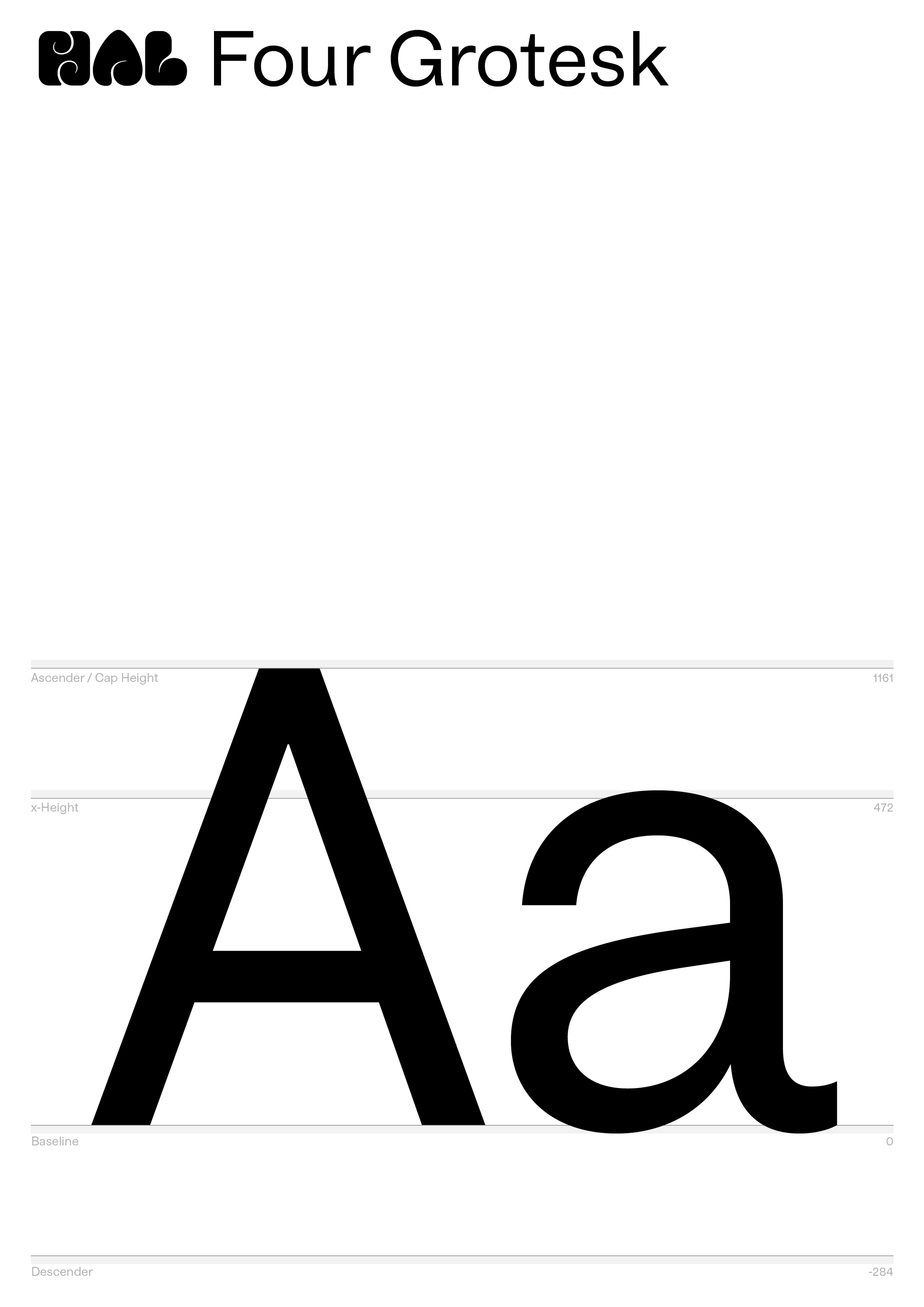
HAL Four Grotesk is an elegant yet reliable addition to the vast, undying sans-serif genre, inspired by Keystone Type Foundry’s Empire Gothic from 1912. This boldly authentic, italicised style from a century ago laid the foundation for further developing HAL Four into a versatile, all-purpose neo-grotesque. Four’s overall appearance is bound by neutral and friendly shapes whilst simultaneously embodying an individual personality to stand out in the crowd.

Credits

Design: HAL Typefaces
Production: HAL Typefaces
Volume: 16 styles, VF
File Formats: otf, ttf, woff, woff2
Release Year: 2022
Spacing/Kerning: Igino Marini

Supported Languages

Abron, Abua, Acheron, Achinese, Acholi, Achuar-Shiwiar, Adamawa Fulfulde, Adangme, Afar, Afrikaans, Aguaruna, Ahtna, Akoose, Alekano, Aleut, Alonquin, Amahuaca, Amarakaeri, Amis, Anaang, Andaandi, Dongolawi, Angas, Anufo, Anuta, Arabela, Aragonese, Arbëreshë Albanian, Asháninka, Ashéninka Perené, Asturian, Atayal, Awa-Cuaiquer, Awing, Baatonum, Bafia, Bagirmi Fulfulde, Balante-Ganja, Balinese, Balkan Romani, Bambara, Banjar, Baoulé, Bari, Basque, Bassari, Batak Dairi, Batak Karo, Batak Mandailing, Batak Simalungun, Batak Toba, Bemba (Zambia), Bena (Tanzania), Biali, Bikol, Bini, Bislama, Bomu, Bora, Borana-Arsi-Guji Oromo, Borgu Fulfulde, Bosnian, Breton, Buginese, Candoshi-Shapra, Caquinte, Cashibo-Cacataibo, Cashinahua, Catalan, Cebuano, Central Aymara, Central Kurdish, Central Nahuatl, Central-Eastern Niger Fulfulde, Cerma, Chachi, Chamorro, Chavacano, Chayahuita, Chiga, Chiltepec Chinantec, Chokwe, Chuukese, Cimbrian, Cofán, Cook Islands Māori, Cornish, Corsican, Creek, Crimean Tatar, Croatian, Czech, Danish, Dehu, Dimli, Duala, Dutch, Dyula, Eastern Arrernte, Eastern Maninkakan, Eastern Oromo, Efik, English, Fanti, Faroese, Fijian, Filipino, Finnish, French, Friulian, Ga, Gagauz, Galician, Ganda, German, Gheg Albanian, Gilbertese, Gonja, Gooniyandi, Gourmanchéma, Guadeloupean Creole French, Gusii, Haitian, Hani, Hassaniyya, Hawaiian, Hiligaynon, Hopi, Huastec, Hungarian, Hän, Ibibio, Icelandic, Idoma, Igbo, Iloko, Inari Sami, Indonesian, Irish, Istro Romanian, Italian, Ixcatlán Mazatec, Jamaican Creole English, Javanese, Jenaama Bozo, Jola-Fonyi, K'iche', Kabuverdianu, Kaingang, Kala Lagaw Ya, Kalaallisut, Kalenjin, Kamba (Kenya), Kaonde, Kaqchikel, Kara-Kalpak, Karelian, Kashubian, Kekchí, Kenzi, Mattokki, Khasi, Kikuyu, Kimbundu, Kinyarwanda, Kirmanjki, Kituba (DRC), Kongo, Konzo, Koyraboro Senni Songhai, Krio, Kven Finnish, Kölsch, Ladin, Ladino, Latgalian, Lingala, Lithuanian, Lombard, Low German, Lower Sorbian, Lozi, Luba-Lulua, Lule Sami, Luo (Kenya and Tanzania), Luxembourgish, Maasina Fulfulde, Macedo-Romanian, Madurese, Makonde, Malagasy, Malaysian, Maltese, Mam, Mamara Senoufo, Mandinka, Mandjak, Mankanya, Manx, Maore Comorian, Maori, Mapudungun, Matsés, Mauritian Creole, Mende (Sierra Leone), Meriam Mir, Meru, Metlatónoc Mixtec, Mi'kmaq, Minangkabau, Mirandese, Mizo, Mohawk, Montenegrin, Munsee, Murrinh-Patha, Murui Huitoto, Muslim Tat, Mwani, Ménik, Mískito, Naga Pidgin, Ndonga, Neapolitan, Ngazidja Comorian, Nigerian Fulfulde, Niuean, Nobiin, Nomatsiguenga, Noon, North Azerbaijani, North Marquesan, North Ndebele, Northern Kissi, Northern Kurdish, Northern Qiandong Miao, Northern Sami, Northern Uzbek, Norwegian, Nyamwezi, Nyanja, Nyankole, Nzima, Occitan, Orma, Oroqen, Otuho, Palauan, Pampanga, Papiamento, Pedi, Picard, Pichis Ashéninka, Piemontese, Pijin, Pintupi-Luritja, Pite Sami, Pohnpeian, Polish, Portuguese, Potawatomi, Pulaar, Páez, Quechua, Romanian, Romansh, Rotokas, Rundi, Saafi-Saafi, Samoan, Sango, Sangu (Tanzania), Saramaccan, Sardinian, Scots, Scottish Gaelic, Sena, Seri, Seselwa Creole French, Sharanahua, Shawnee, Shilluk, Shipibo-Conibo, Shona, Shuar, Sicilian, Silesian, Slovak, Slovenian, Soga, Somali, Soninke, South Azerbaijani, South Marquesan, South Ndebele, Southern Aymara, Southern Bobo Madaré, Southern Dagaare, Southern Qiandong Miao, Southern Sami, Southern Sotho, Spanish, Sranan Tongo, Standard Estonian, Standard Latvian, Standard Malay, Sundanese, Susu, Swahili, Swedish, Swiss German, Syenara Senoufo, Tagalog, Tahitian, Talysh, Tedim Chin, Tetum, Tetun Dili, Timne, Tiéyaxo Bozo, Toba, Tok Pisin, Tokelau, Tonga (Tonga Islands), Tosk Albanian, Tsakhur, Tumbuka, Turkish, Turkmen, Tuvalu, Twi, Tzeltal, Tzotzil, Uab Meto, Umbundu, Ume Sami, Upper Guinea Crioulo, Upper Sorbian, Venetian, Veps, Vietnamese, Vlax Romani, Võro, Wallisian, Walloon, Walser, Wamey, Waray (Philippines), Warlpiri, Wasa, Wayuu, Welsh, West Central Oromo, West-Central Limba, Western Abnaki, Western Frisian, Western Niger Fulfulde, Wiradjuri, Wolof, Xhosa, Yagua, Yanesha', Yao, Yoruba, Yucateco, Zarma, Zulu, Zuni, Záparo
Typeface in use
PDF Specimen
Four Grotesk

In Use

Artbar, Museum of Contemporary Art Australia (MCA) Design by Supermega, 2023

Zwischen Spiele, University of Potsdam Design by Bernd Grether & Sam Kim, 2023

Sign Up to the HAL Newsletter

Illustration
  • © 2026 HAL Typefaces
  • Newsletter
  • Cookies & Privacy
Four GroteskGapMagicMatexRepostTimezoneColantTwins