Overview
Standard
Size
Features
Size
Features
Features
Glyphs
▼Basic Characters
▼Punctuation
▼Circled Figures
▼Language Extension
▼Fractions and Ordinals
▼Superscript and Subscript
▼Currency and Math
▼Arrows and Symbols
Info
Description
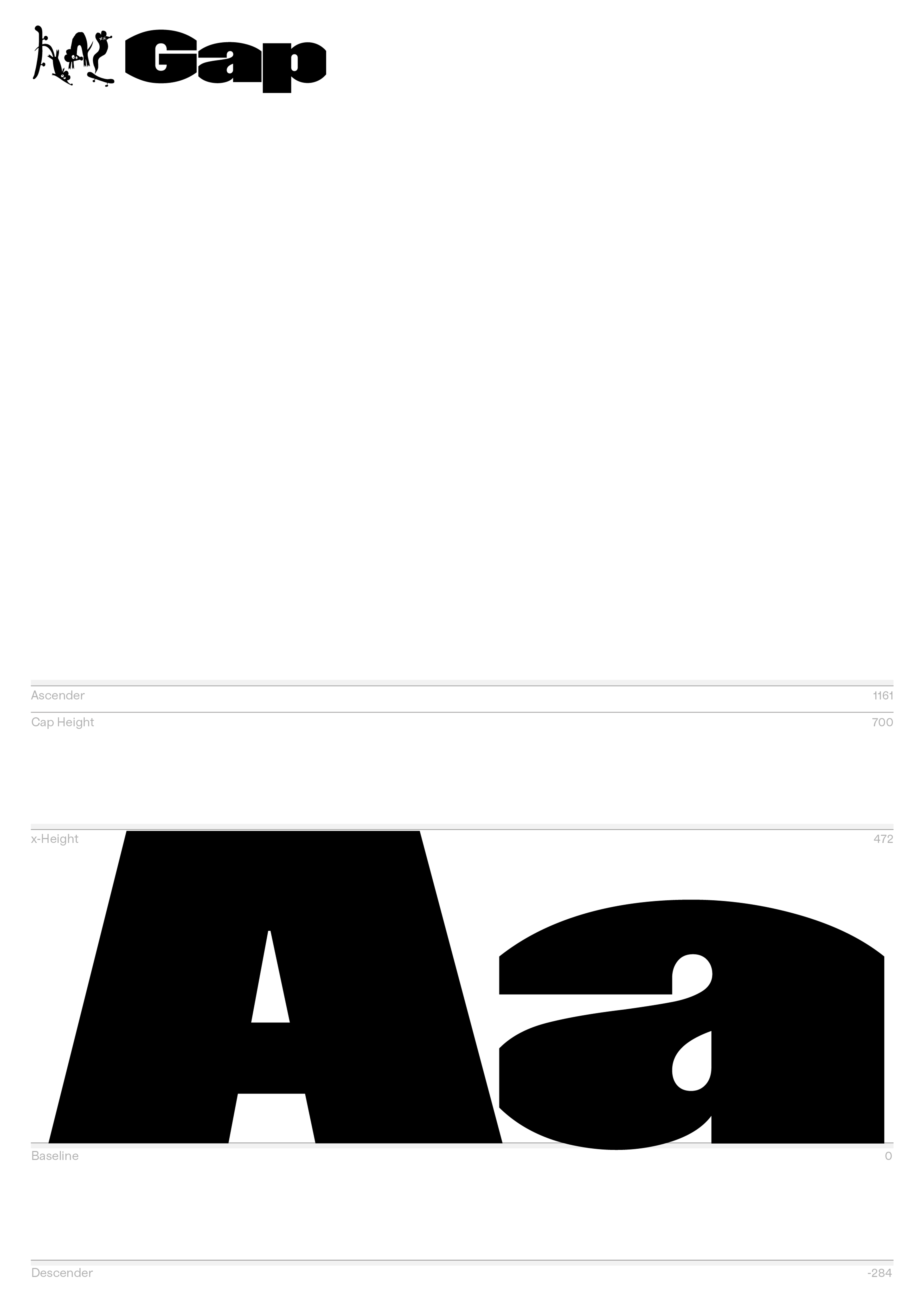
HAL Gap is a powerful display sans. The keen gesture of slicing and chopping the ends off the round characters, allows for tight spacing and a sharp appearance, perfect for those mighty headlines. Originally inspired by Leporello, Friedrich Poppl’s 1977 design for Berthold, Gap comes in seven individual styles, diverging in width and weight. They range from an extremely thin and compressed XXS to a wide and heavy XXL. All static styles are encased in a gutsy variable font, seamlessly shaping countless instances in between.
Credits
Design: HAL Typefaces
Production: HAL Typefaces
Volume: 7 styles, VF
File Formats: otf, ttf, woff, woff2
Release Year: 2025
Spacing/Kerning: HAL Typefaces
Supported Languages
Abron, Abua, Acheron, Achinese, Acholi, Achuar-Shiwiar, Adamawa Fulfulde, Adangme, Afar, Afrikaans, Aguaruna, Ahtna, Akoose, Alekano, Aleut, Alonquin, Amahuaca, Amarakaeri, Amis, Anaang, Andaandi, Dongolawi, Angas, Anufo, Anuta, Arabela, Aragonese, Arbëreshë Albanian, Asháninka, Ashéninka Perené, Asturian, Atayal, Awa-Cuaiquer, Awing, Baatonum, Bafia, Bagirmi Fulfulde, Balante-Ganja, Balinese, Balkan Romani, Bambara, Banjar, Baoulé, Bari, Basque, Bassari, Batak Dairi, Batak Karo, Batak Mandailing, Batak Simalungun, Batak Toba, Bemba (Zambia), Bena (Tanzania), Biali, Bikol, Bini, Bislama, Boko (Benin), Bomu, Bora, Borana-Arsi-Guji Oromo, Borgu Fulfulde, Bosnian, Breton, Buginese, Bushi, Candoshi-Shapra, Caquinte, Caribbean Hindustani, Cashibo-Cacataibo, Cashinahua, Catalan, Cebuano, Central Aymara, Central Kurdish, Central Nahuatl, Central-Eastern Niger Fulfulde, Cerma, Chachi, Chamorro, Chavacano, Chayahuita, Chiga, Chiltepec Chinantec, Chokwe, Chuukese, Cimbrian, Cofán, Cook Islands Māori, Cornish, Corsican, Creek, Crimean Tatar, Croatian, Czech, Danish, Dehu, Dimli, Duala, Dutch, Dyan, Dyula, Eastern Arrernte, Eastern Maninkakan, Eastern Oromo, Efik, English, Fanti, Faroese, Fijian, Filipino, Finnish, French, Friulian, Ga, Gagauz, Galician, Ganda, Garifuna, German, Gheg Albanian, Gilbertese, Gonja, Gooniyandi, Gourmanchéma, Guadeloupean Creole French, Gusii, Haitian, Hani, Hassaniyya, Hausa, Hawaiian, Hiligaynon, Hopi, Huastec, Hungarian, Hän, Ibibio, Icelandic, Idoma, Igbo, Iloko, Inari Sami, Indonesian, Irish, Istro Romanian, Italian, Ixcatlán Mazatec, Jamaican Creole English, Javanese, Jenaama Bozo, Jola-Fonyi, K’iche’, Kabuverdianu, Kaingang, Kako, Kala Lagaw Ya, Kalaallisut, Kalenjin, Kamba (Kenya), Kaonde, Kaqchikel, Kara-Kalpak, Karelian, Kashubian, Kekchí, Kenzi, Mattokki, Khasi, Kikuyu, Kimbundu, Kinyarwanda, Kirmanjki, Kituba (DRC), Kom (Cameroon), Kongo, Konzo, Koyraboro Senni Songhai, Krio, Kven Finnish, Kölsch, Ladin, Ladino, Latgalian, Lingala, Lithuanian, Lombard, Low German, Lower Sorbian, Lozi, Luba-Lulua, Lule Sami, Luo (Kenya and Tanzania), Luxembourgish, Maasina Fulfulde, Macedo-Romanian, Madurese, Makonde, Malagasy, Malaysian, Maltese, Mam, Mamara Senoufo, Mandinka, Mandjak, Mankanya, Manx, Maore Comorian, Maori, Mapudungun, Marshallese, Matsés, Mauritian Creole, Mende (Sierra Leone), Meriam Mir, Meru, Metlatónoc Mixtec, Mi’kmaq, Minangkabau, Mirandese, Mizo, Mohawk, Montenegrin, Munsee, Murrinh-Patha, Murui Huitoto, Muslim Tat, Mwani, Ménik, Mískito, Naga Pidgin, Ndonga, Neapolitan, Ngazidja Comorian, Nigerian Fulfulde, Niuean, Nobiin, Nomatsiguenga, Noon, North Azerbaijani, North Marquesan, North Ndebele, Northern Kissi, Northern Kurdish, Northern Qiandong Miao, Northern Sami, Northern Uzbek, Norwegian, Nyamwezi, Nyanja, Nyankole, Nyemba, Nzima, Occitan, Ojitlán Chinantec, Orma, Oroqen, Otuho, Palauan, Pampanga, Papantla Totonac, Papiamento, Paraguayan Guaraní, Pedi, Picard, Pichis Ashéninka, Piemontese, Pijin, Pintupi-Luritja, Pipil, Pite Sami, Pohnpeian, Polish, Portuguese, Potawatomi, Pulaar, Purepecha, Páez, Quechua, Romanian, Romansh, Rotokas, Rundi, Saafi-Saafi, Samoan, Sango, Sangu (Tanzania), Saramaccan, Sardinian, Scots, Scottish Gaelic, Sena, Seri, Seselwa Creole French, Sharanahua, Shawnee, Shilluk, Shipibo-Conibo, Shona, Shuar, Sicilian, Silesian, Slovak, Slovenian, Soga, Somali, Soninke, South Azerbaijani, South Marquesan, South Ndebele, Southern Aymara, Southern Bobo Madaré, Southern Dagaare, Southern Qiandong Miao, Southern Sami, Southern Sotho, Spanish, Sranan Tongo, Standard Estonian, Standard Latvian, Standard Malay, Sundanese, Susu, Swahili, Swedish, Swiss German, Syenara Senoufo, Tagalog, Tahitian, Talysh, Tedim Chin, Tetum, Tetun Dili, Timne, Tiéyaxo Bozo, Toba, Tok Pisin, Tokelau, Tonga (Tonga Islands), Tonga (Zambia), Tosk Albanian, Tsakhur, Tumbuka, Turkish, Turkmen, Tuvalu, Twi, Tzeltal, Tzotzil, Uab Meto, Umbundu, Ume Sami, Upper Guinea Crioulo, Upper Sorbian, Venetian, Veps, Vietnamese, Vlax Romani, Võro, Wallisian, Walloon, Walser, Wamey, Waray (Philippines), Warlpiri, Wasa, Wayuu, Welsh, West Central Oromo, West-Central Limba, Western Abnaki, Western Frisian, Western Niger Fulfulde, Wiradjuri, Wolof, Xhosa, Yagua, Yanesha’, Yao, Yoruba, Yucateco, Zapotec, Zarma, Zulu, Zuni, Záparo
In Use
mowe Festival für Kunst und Stadtkultur Design by Studio Itch, 2026
