↑
  • HAL Typefaces
  • Collection
  • Licensing
  • Notes
  • About
  • Trial Fonts
  • Collection
  • Licensing
  • Notes
  • About
  • Trial Fonts
  • © 2026 HAL Typefaces
  • Newsletter
  • Cookies & Privacy
Four GroteskGapMagicMatexRepostTimezoneColantTwins
  • Repost
  • Standard
  • Mono
  • Features
  • Glyphs
  • Info
  • In Use

Overview

Repost Standard
Regular
Regular Italic
Repost Mono
Regular
Regular Italic

Standard

Size
 
Features
Typewriter
Size
 
Features
Both Expressmen were hired at St. Joseph for A. E. Lewis’ Division, which ran from St. Joseph to Seneca, Kansas, a distance of 80 miles (130 km). They covered at an average speed of 12 1⁄2 miles per hour (20 km/h), including all stops. Before the mail pouch was delivered to the first rider on April 3, 1860, time was taken out for ceremonies and several speeches. First, Mayor M. Jeff Thompson gave a brief speech on the significance of the event for St. Joseph. Then William H. Russell and Alexander Majors addressed the gala crowd about how the Pony Express was just a »precursor« to the construction of a transcontinental railroad. At the conclusion of all the speeches, around 7:15 pm, Russell turned the mail pouch over to the first rider. A cannon fired, the large assembled crowd cheered, and the rider dashed to the landing at the foot of Jules Street, where the ferry boat Denver, under a full head of steam, alerted by the signal cannon, waited to carry the horse and rider across the Missouri River to Elwood, Kansas Territory. On April 9 at 6:45 pm, the first rider from the east reached Salt Lake City, Utah. Then, on April 12, the mail pouch reached Carson City, Nevada Territory, at 2:30 pm. The riders raced over the Sierra Nevada, through Placerville, California, and on to Sacramento. Around midnight on April 14, 1860, the first mail pouch was delivered by the Pony Express to San Francisco, Golden State, California. Mayor M. Jeff Thompson gave a brief speech on the significance of the event.
Size
 
Features
Lettre Américaine Groupe La Poste Helsingborg Daily
Size
 
Features
Royal Mail
Size
 
Features
V-mail correspondence was on small letter sheets, 17.8 by 23.2 cm (7 by 9 1⁄8 in), that would go through mail censors before being photographed and transported as thumbnail-sized image in negative microfilm. Upon arrival to their destination, the negatives would be printed. The final print was 60% of the original document's size, creating a sheet 10.7 by 13.2 cm (4 1⁄4 by 5 1⁄4 in). According to the National Postal Museum, V-mail ensured that thousands of tons of shipping space could be reserved for war materials. The 37 mail bags required to carry 150,000 one-page letters could be replaced by a single mail sack. The weight of that same amount of mail was reduced dramatically from 2,575 pounds to a mere 45. This saved considerable weight and bulk in a time in which both were hard to manage in a combat zone. In addition to postal censorship, V-mail also deterred espionage communications by foiling the use of invisible ink, microdots, and microprinting, none of which would be reproduced in a photocopy. The “airgraph” was invented in the 1930s by the Eastman Kodak Company in conjunction with Imperial Airways (now British Airways) and Pan-American Airways as a means of reducing the weight and bulk of mail carried by air. The airgraph forms, upon which the letter was written, were photographed and then sent as negatives on rolls of microfilm. A General Post Office (GPO) poster of the time claimed that 1,600 letters on film weighed just 5 oz (140 g), while 1,600 ordinary letters weighed 50 lb (23 kg). At their destination, the negatives were printed on photographic paper and delivered as airgraph letters through the normal Royal Engineers (Postal Section) – also known as the Army Postal Services (APS) – systems. According to the National Postal Museum, V-mail ensured that thousands of tons of shipping space could be reserved for war materials.
Size
 
Features
British Patent 1879 “Electric Telegraph” Microphone Radio

Mono

Size
 
Features
Pennsylvania Indianapolis
Size
 
Features
As a method of communication, it is likely as old as the ancient Persians, from whom the art of training the birds probably came. The Romans used pigeon messengers to aid their military over 2000 years ago. Frontinus said that Julius Caesar used pigeons as messengers in his conquest of Gaul. The Greeks conveyed the names of the victors at the Olympic Games to their various cities by this means. Naval chaplain Henry Teonge (1620–1690) describes in his diary a regular pigeon postal service being used by merchants between İskenderun and Aleppo in the Levant. The Mughals also used messenger pigeons. Before the telegraph, this method of communication was used extensively in the financial field. The Dutch government established a civil and military system in Java and Sumatra early in the 19th century, the birds being obtained from Baghdad. In 1851, the German-born Paul Julius Reuter opened an office in the City of London which transmitted stock market quotations between London and Paris via the new Calais to Dover cable. Reuter had previously used pigeons to fly stock prices between Aachen and Brussels, a service that operated for a year until a gap in the telegraph link was closed.
Size
 
Features
Intl. Herald Tribune Quintessence of Political Journalism
Size
 
Features
Routemaster
Size
 
Features
Details of the employment of pigeons during the siege of Paris in 1870–71 led to a revival in the training of pigeons for military purposes. Numerous societies were established for keeping pigeons of this class in all important European countries; and, in time, various governments established systems of communication for military purposes by pigeon post. After pigeon post between military fortresses had been thoroughly tested, attention was turned to its use for naval purposes, to send messages to ships in nearby waters. It was also used by news agencies and private individuals at various times. Governments in several countries established lofts of their own. Laws were passed making the destruction of such pigeons a serious offense; premiums to stimulate efficiency were offered to private societies, and rewards given for destruction of birds of prey. Before the advent of radio, pigeons were used by newspapers to report yacht races, and some yachts were actually fitted with lofts. During the establishment of formal pigeon post services, the registration of all birds was introduced. At the same time, in order to hinder the efficiency of the systems of foreign countries, difficulties were placed in the way of the importation of their birds for training, and in a few cases falcons were specially trained to interrupt the service during war, the Germans having set the example by employing hawks against the Paris pigeons in 1870–71. No satisfactory method of protecting the weaker birds seems to have been developed, though the Chinese formerly provided their pigeons with whistles and bells to scare away birds of prey. As radio telegraphy and telephony were developed, the use of pigeons became limited to fortress warfare by the 1910s. Although the British Admiralty had attained a very high standard of efficiency, it discontinued its pigeon service in the early 20th century. In contrast, large numbers of birds were still kept by France, Germany and Russia at the outbreak of the First World War. In modern days, some rafting photographers still use pigeons as a sneakernet to transport digital photos on flash media from the camera to the tour operator.
Size
 
Features
Plymouth Southwest Express Matchsticks Bristol Highstreet

Features

Glyphs

▼Basic Characters
▼Punctuation
▼Oldstyle and Tabular Figures
▼Roman and Circled Figures
▼Language Extension
▼Fractions and Ordinals
▼Superscript and Subscript
▼Currency and Math
▼Arrows and Symbols

Info

Description

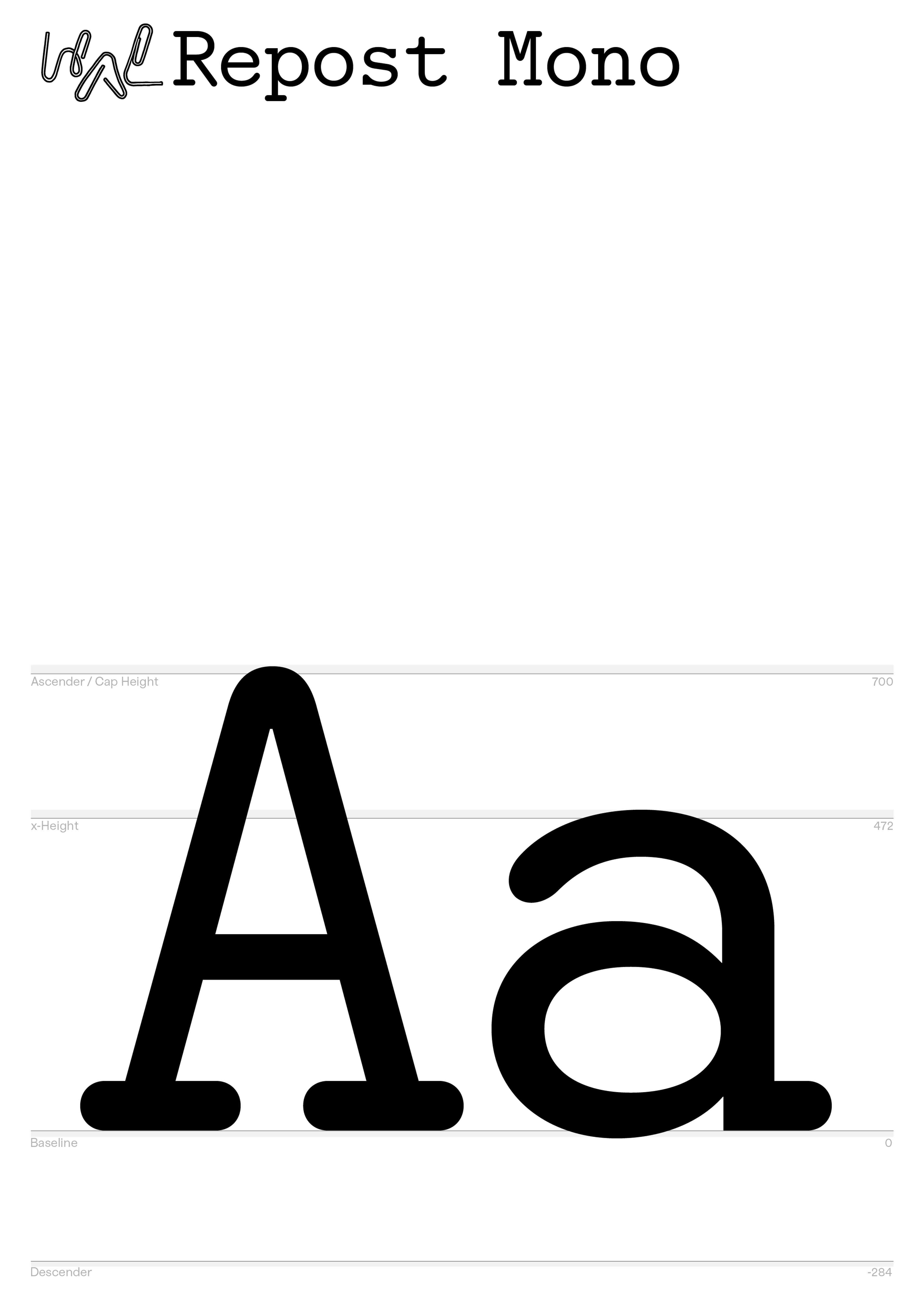
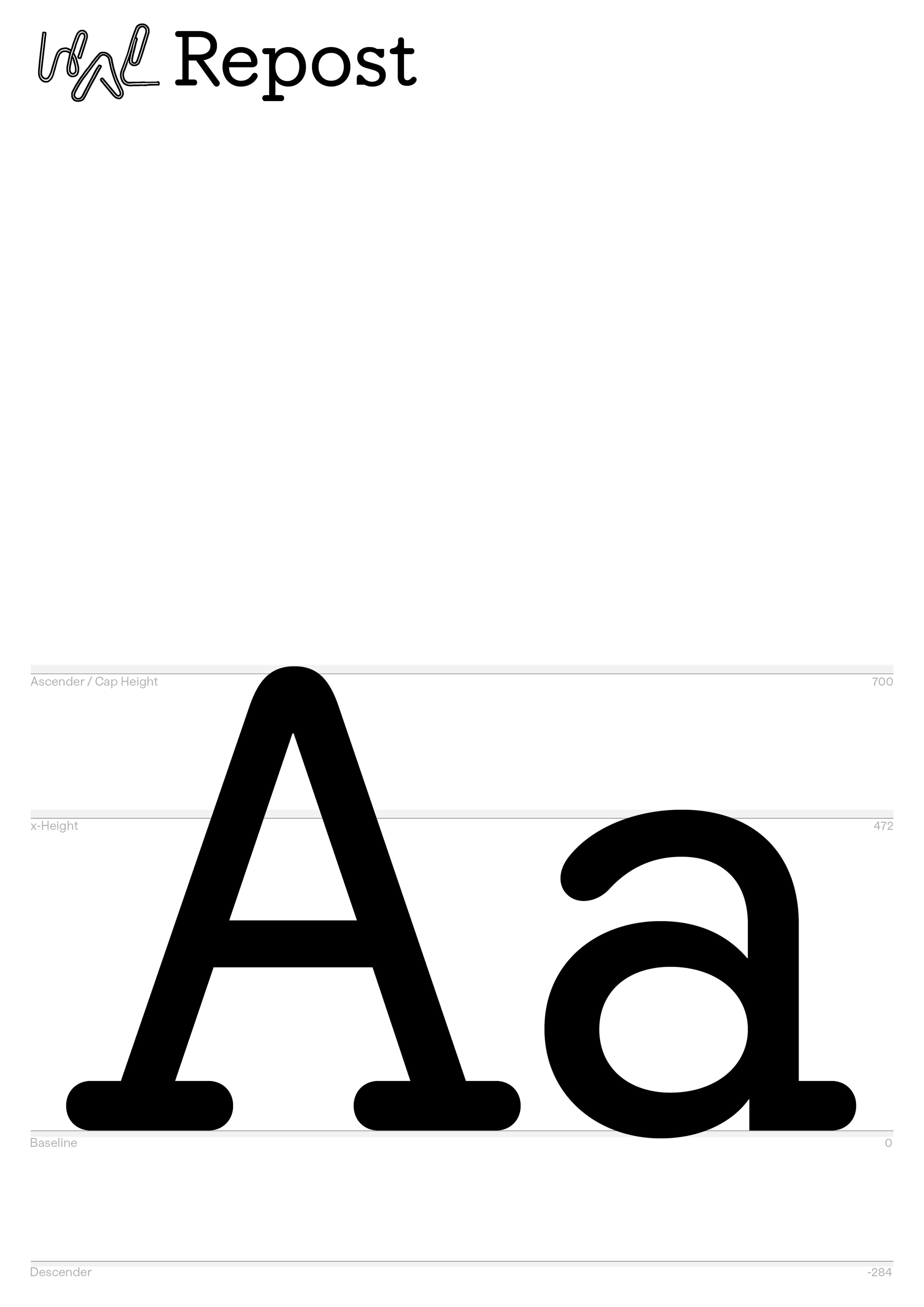
HAL Repost is a friendly, monolinear slab serif with rounded terminal endings, inspired by ATF’s Post Monotone No. 2 (a condensed version of Post Monotone, originally designed in 1903 for the Saturday Evening Post). The stylistic extension includes Regular, Regular Italic, Mono and Mono Italic. As dependable as a stable typewriter font, Repost’s winsome spirit is pleasantly charming and filled with character.

Credits

Design: HAL Typefaces
Production: HAL Typefaces
Volume: 2 families, 4 styles
File Formats: otf, ttf, woff, woff2
Release Year: 2024
Spacing/Kerning: Igino Marini

Supported Languages

Abron, Abua, Acheron, Achinese, Acholi, Achuar-Shiwiar, Adamawa Fulfulde, Adangme, Afar, Afrikaans, Aguaruna, Alekano, Aleut, Alonquin, Amahuaca, Amarakaeri, Amis, Anaang, Andaandi, Dongolawi, Anufo, Anuta, Arabela, Aragonese, Arbëreshë Albanian, Asháninka, Ashéninka Perené, Asturian, Atayal, Awa-Cuaiquer, Baatonum, Bafia, Bagirmi Fulfulde, Balante-Ganja, Balinese, Balkan Romani, Bambara, Banjar, Baoulé, Bari, Basque, Bassari, Batak Dairi, Batak Karo, Batak Mandailing, Batak Simalungun, Batak Toba, Bemba (Zambia), Bena (Tanzania), Biali, Bikol, Bini, Bislama, Bora, Borana-Arsi-Guji Oromo, Borgu Fulfulde, Bosnian, Breton, Buginese, Candoshi-Shapra, Caquinte, Cashibo-Cacataibo, Cashinahua, Catalan, Cebuano, Central Aymara, Central Kurdish, Central Nahuatl, Central-Eastern Niger Fulfulde, Cerma, Chachi, Chamorro, Chavacano, Chayahuita, Chiga, Chiltepec Chinantec, Chokwe, Chuukese, Cimbrian, Cofán, Cook Islands Māori, Cornish, Corsican, Creek, Crimean Tatar, Croatian, Czech, Danish, Dehu, Dimli, Duala, Dutch, Dyula, Eastern Arrernte, Eastern Maninkakan, Eastern Oromo, Efik, English, Fanti, Faroese, Fijian, Filipino, Finnish, French, Friulian, Ga, Gagauz, Galician, Ganda, German, Gheg Albanian, Gilbertese, Gonja, Gooniyandi, Gourmanchéma, Guadeloupean Creole French, Gusii, Haitian, Hani, Hiligaynon, Hopi, Huastec, Hungarian, Hän, Ibibio, Icelandic, Idoma, Igbo, Iloko, Inari Sami, Indonesian, Irish, Istro Romanian, Italian, Ixcatlán Mazatec, Jamaican Creole English, Javanese, Jenaama Bozo, Jola-Fonyi, K’iche’, Kabuverdianu, Kaingang, Kala Lagaw Ya, Kalaallisut, Kalenjin, Kamba (Kenya), Kaonde, Kara-Kalpak, Karelian, Kashubian, Kekchí, Kenzi, Mattokki, Khasi, Kikuyu, Kimbundu, Kinyarwanda, Kirmanjki, Kituba (DRC), Kongo, Konzo, Koyraboro Senni Songhai, Krio, Kven Finnish, Kölsch, Ladin, Ladino, Latgalian, Lingala, Lithuanian, Lombard, Low German, Lower Sorbian, Luba-Lulua, Lule Sami, Luo (Kenya and Tanzania), Luxembourgish, Maasina Fulfulde, Macedo-Romanian, Madurese, Makonde, Malagasy, Malaysian, Maltese, Mam, Mamara Senoufo, Mandinka, Mandjak, Mankanya, Manx, Maore Comorian, Maori, Mapudungun, Matsés, Mauritian Creole, Mende (Sierra Leone), Meriam Mir, Meru, Metlatónoc Mixtec, Mi’kmaq, Minangkabau, Mirandese, Mizo, Mohawk, Montenegrin, Munsee, Murrinh-Patha, Murui Huitoto, Mwani, Ménik, Mískito, Naga Pidgin, Ndonga, Neapolitan, Ngazidja Comorian, Nigerian Fulfulde, Niuean, Nobiin, Nomatsiguenga, North Ndebele, Northern Kissi, Northern Kurdish, Northern Qiandong Miao, Northern Sami, Northern Uzbek, Norwegian, Nyamwezi, Nyanja, Nyankole, Nzima, Occitan, Orma, Oroqen, Palauan, Pampanga, Papiamento, Pedi, Picard, Pichis Ashéninka, Piemontese, Pijin, Pintupi-Luritja, Pohnpeian, Polish, Portuguese, Potawatomi, Pulaar, Páez, Quechua, Romanian, Romansh, Rotokas, Rundi, Saafi-Saafi, Samoan, Sango, Sangu (Tanzania), Saramaccan, Sardinian, Scots, Scottish Gaelic, Sena, Seri, Seselwa Creole French, Sharanahua, Shawnee, Shilluk, Shipibo-Conibo, Shona, Shuar, Sicilian, Silesian, Slovak, Slovenian, Soga, Somali, Soninke, South Ndebele, Southern Aymara, Southern Bobo Madaré, Southern Dagaare, Southern Qiandong Miao, Southern Sami, Southern Sotho, Spanish, Sranan Tongo, Standard Estonian, Standard Latvian, Standard Malay, Sundanese, Susu, Swahili, Swedish, Swiss German, Syenara Senoufo, Tagalog, Tahitian, Tedim Chin, Tetum, Tetun Dili, Timne, Tiéyaxo Bozo, Toba, Tok Pisin, Tokelau, Tonga (Tonga Islands), Tosk Albanian, Tumbuka, Turkish, Turkmen, Tuvalu, Twi, Tzeltal, Tzotzil, Uab Meto, Umbundu, Ume Sami, Upper Guinea Crioulo, Upper Sorbian, Venetian, Veps, Vietnamese, Vlax Romani, Võro, Walloon, Walser, Wamey, Waray (Philippines), Warlpiri, Wasa, Wayuu, Welsh, West Central Oromo, West-Central Limba, Western Abnaki, Western Frisian, Western Niger Fulfulde, Wiradjuri, Wolof, Xhosa, Yagua, Yanesha’, Yao, Yoruba, Yucateco, Zarma, Zulu, Záparo
Typeface in use
PDF Specimen
Repost
Typeface in use
PDF Specimen
Repost Mono

In Use

Navigating Change Through Conscious Design Education Institutional Plan 2025–28, Design Academy Eindhoven Design by Pedro Lobo, 2025

I said, ‘Auf Wiedersehen’ – 85 Years of Kindertransport to Britain Design by Distaff Studio, 2024

Sign Up to the HAL Newsletter

Illustration