↑
  • HAL Typefaces
  • Collection
  • Licensing
  • Notes
  • About
  • Trial Fonts
  • Collection
  • Licensing
  • Notes
  • About
  • Trial Fonts
  • © 2026 HAL Typefaces
  • Newsletter
  • Cookies & Privacy
Four GroteskGapMagicMatexRepostTimezoneColantTwins
  • Twins
  • Standard
  • Variable
  • Features
  • Glyphs
  • Info
  • In Use

Overview

Light (00)
Semi-Light (01)
Semi-Bold (10)
Bold (11)
Variable

Standard

Size
 
Features
Publicité
Size
 
Features
Sci-fi Code the MATRIX Humanoid Robotics Ding(bats) & Industrial
Size
 
Features
The ISO standard ISO 2033:1983, and the corresponding Japanese Industrial Standard JIS X 9010:1984 (originally JIS C 6229–1984), define character encodings for OCR-A, OCR-B and E-13B. There are two major MICR fonts in use: E-13B and CMC-7. There is no particular international agreement on which countries use which font. In practice, this does not create particular problems as cheques and other vouchers do not usually flow out of a particular jurisdiction. The E-13B font has been adopted as an international standard in ISO 1004-1:2013, and is the standard in Australia, Canada, the United Kingdom, the United States, as well as Central America and much of Asia, besides other countries. The CMC-7 font has been adopted as an international standard in ISO 1004-2:2013, and is widely used in Europe, including France and Italy, Mexico, and South America, including Argentina, Brazil, Chile, besides other countries. Israel is the only country that can use both fonts simultaneously, though the practice makes the system significantly less efficient. This situation is the product of the Israelis adopting CMC-7, while the Palestinians opted for E-13B.
Size
 
Features
Computer
Size
 
Features
Magnetic Ink-Toner “Osaka” Japan Iron 1/8 Oxidation
Size
 
Features
MICR characters are printed on documents in one of the two MICR fonts, using magnetizable (commonly known as magnetic) ink or toner, usually containing iron oxide. In scanning, the document is passed through a MICR reader, which performs two functions: magnetization of the ink, and detection of the characters. The characters are read by a MICR reader head, a device similar to the playback head of a tape recorder. As each character passes over the head, it produces a unique waveform that can be easily identified by the system. MICR readers are the primary tool for cheque sorting and are used across the cheque distribution network at multiple stages. For example, a merchant will use a MICR reader to sort cheques by bank and send the sorted cheques to a clearing house for redistribution to those banks. Upon receipt, the banks perform another MICR sort to determine which customer's account is charged and to which branch the cheque should be sent on its way back to the customer. However, many banks no longer offer this last step of returning the cheque to the customer. Instead, cheques are scanned and stored digitally. Sorting of cheques is done as per the geographical coverage of banks in a nation.
Size
 
Features
June 1973
Size
 
Features
Advertising Dept. Pisa, Italy ❹❺ Web Linux Trinity
Size
 
Features
Before the mid-1940s, cheques were processed manually using the Sort-A-Matic or Top Tab Key method. The processing and cheque clearing was very time-consuming and was a significant cost in cheque clearance and bank operations. As the number of cheques increased, ways were sought for automating the process. Standards were developed to ensure uniformity in financial institutions. By the mid-1950s, the Stanford Research Institute and General Electric Computer Laboratory had developed the first automated system to process cheques using MICR. The same team also developed the E-13B MICR font. “E” refers to the font being the fifth considered, and "B" to the fact that it was the second version. The “13” refers to the 0.013-inch character grid. The trial of MICR E-13B font was shown to the American Bankers Association (ABA) in July 1956, which adopted it in 1958 as the MICR standard for negotiable documents in the United States. ABA adopted MICR as its standard because machines could read MICR accurately, and MICR could be printed using existing technology. In addition, MICR remained machine readable, even through overstamping, marking, mutilation and more. The first cheques using MICR were printed by the end of 1959. Although compliance with MICR standards was voluntary in the United States, it had been almost universally adopted in the United States by 1963. In 1963, ANSI adopted the ABA's E-13B font as the American standard for MICR printing, and E-13B was also standardized as ISO 1004:1995.
Size
 
Features
Electro-Ace
Size
 
Features
In the 1960s, MICR fonts became a Symbol of Modernity and Futurism
Size
 
Features
One of the biggest problems found in the second phase was how to input the check information, especially the account numbers, with any sort of speed. Beise demanded a system that would not require the information to be changed from one medium to another, from check to punched card for instance, while simultaneously lowering error rates. SRI investigated several solutions to the problem, including the first OCR system from a company in Arlington, Virginia. However, they found that it was all too easy for banks, and customers, to write over the account numbers and spoil the system. They also experimented with barcode information, and while this worked well even when printed over, if there was enough "damage" to the code a human operator could not read them in order to input them manually. Instead, they decided to combine the two technologies, and used MICR-printed account numbers which could be read by a magnetic reader similar to those in a cassette tape recorder. The resulting reader was a mechanical tour-de-force, combining five MICR readers with a large rotating drum that forced checks dumped in the top to come out the bottom single-file. The system was eventually able to read ten checks a second, with errors on the order of 1 per 100,000 checks.

Variable


Features

Glyphs

▼Basic Characters
▼Punctuation
▼Circled Figures
▼Language Extension
▼Fractions and Ordinals
▼Superscript and Subscript
▼Currency and Math
▼Arrows and Symbols

Info

Description

HAL Twins continues spiritually and methodically where Gemini left off. The 1960’s design by Franco Grignani was one of the first typefaces to adopt the characteristic style of machine-readable magnetic ink numerals to letterforms, applying stark contrast between horizontal and vertical stem weights. Expanding on this idiosyncratic concept, Twins variably shifts between its binary states: light (00), semi-light (01), semi-bold (10) and bold (11). The basic, rounded shapes playfully convey a sense of fundamental simplicity and industrial quirkiness.

Credits

Design: HAL Typefaces
Production: HAL Typefaces
Volume: 4 styles, VF
File Formats: otf, ttf, woff, woff2
Release Year: 2023
Spacing/Kerning: HAL Typefaces

Supported Languages

Acheron, Achinese, Acholi, Achuar-Shiwiar, Afar, Afrikaans, Aguaruna, Alekano, Aleut, Alonquin, Amahuaca, Amarakaeri, Amis, Anaang, Andaandi, Dongolawi, Anuta, Aragonese, Arbëreshë Albanian, Asháninka, Ashéninka Perené, Asturian, Atayal, Balinese, Balkan Romani, Banjar, Bari, Basque, Batak Dairi, Batak Karo, Batak Mandailing, Batak Simalungun, Batak Toba, Bemba (Zambia), Bena (Tanzania), Bikol, Bini, Bislama, Borana-Arsi-Guji Oromo, Bosnian, Breton, Buginese, Candoshi-Shapra, Caquinte, Cashibo-Cacataibo, Cashinahua, Catalan, Cebuano, Central Aymara, Central Kurdish, Central Nahuatl, Chachi, Chamorro, Chavacano, Chiga, Chiltepec Chinantec, Chokwe, Chuukese, Cimbrian, Cofán, Cook Islands Māori, Cornish, Corsican, Creek, Crimean Tatar, Croatian, Czech, Danish, Dehu, Dimli, Dutch, Eastern Arrernte, Eastern Oromo, Efik, English, Faroese, Fijian, Filipino, Finnish, French, Friulian, Gagauz, Galician, Ganda, German, Gheg Albanian, Gilbertese, Gooniyandi, Gourmanchéma, Guadeloupean Creole French, Gusii, Haitian, Hani, Hiligaynon, Hopi, Huastec, Hungarian, Hän, Icelandic, Igbo, Iloko, Inari Sami, Indonesian, Irish, Istro Romanian, Italian, Ixcatlán Mazatec, Jamaican Creole English, Javanese, Jola-Fonyi, K'iche', Kabuverdianu, Kaingang, Kala Lagaw Ya, Kalaallisut, Kalenjin, Kamba (Kenya), Kaonde, Kara-Kalpak, Karelian, Kashubian, Kekchí, Kenzi, Mattokki, Khasi, Kikuyu, Kimbundu, Kinyarwanda, Kirmanjki, Kituba (DRC), Kongo, Konzo, Kven Finnish, Kölsch, Ladin, Ladino, Latgalian, Lithuanian, Lombard, Low German, Lower Sorbian, Luba-Lulua, Lule Sami, Luo (Kenya and Tanzania), Luxembourgish, Macedo-Romanian, Madurese, Makonde, Malagasy, Malaysian, Maltese, Mam, Mandinka, Mandjak, Mankanya, Manx, Maore Comorian, Maori, Mapudungun, Matsés, Mauritian Creole, Meriam Mir, Meru, Minangkabau, Mirandese, Mizo, Mohawk, Montenegrin, Munsee, Murrinh-Patha, Mwani, Mískito, Naga Pidgin, Ndonga, Neapolitan, Ngazidja Comorian, Niuean, Nobiin, Nomatsiguenga, North Ndebele, Northern Kurdish, Northern Qiandong Miao, Northern Sami, Northern Uzbek, Norwegian, Nyanja, Nyankole, Occitan, Orma, Oroqen, Palauan, Pampanga, Papiamento, Pedi, Picard, Pichis Ashéninka, Piemontese, Pijin, Pintupi-Luritja, Pohnpeian, Polish, Portuguese, Potawatomi, Páez, Quechua, Romanian, Romansh, Rotokas, Rundi, Samoan, Sango, Sangu (Tanzania), Saramaccan, Sardinian, Scots, Scottish Gaelic, Sena, Seri, Seselwa Creole French, Shawnee, Shipibo-Conibo, Shona, Shuar, Sicilian, Silesian, Slovak, Slovenian, Soga, Somali, Soninke, South Ndebele, Southern Aymara, Southern Qiandong Miao, Southern Sami, Southern Sotho, Spanish, Sranan Tongo, Standard Estonian, Standard Latvian, Standard Malay, Sundanese, Swahili, Swedish, Swiss German, Tagalog, Tahitian, Tedim Chin, Tetum, Tetun Dili, Toba, Tok Pisin, Tokelau, Tonga (Tonga Islands), Tosk Albanian, Tumbuka, Turkish, Turkmen, Tuvalu, Tzeltal, Tzotzil, Uab Meto, Umbundu, Ume Sami, Upper Guinea Crioulo, Upper Sorbian, Venetian, Veps, Vietnamese, Vlax Romani, Võro, Walloon, Walser, Waray (Philippines), Warlpiri, Wayuu, Welsh, West Central Oromo, Western Abnaki, Western Frisian, Wiradjuri, Wolof, Xhosa, Yanesha', Yao, Yucateco, Zulu, Záparo
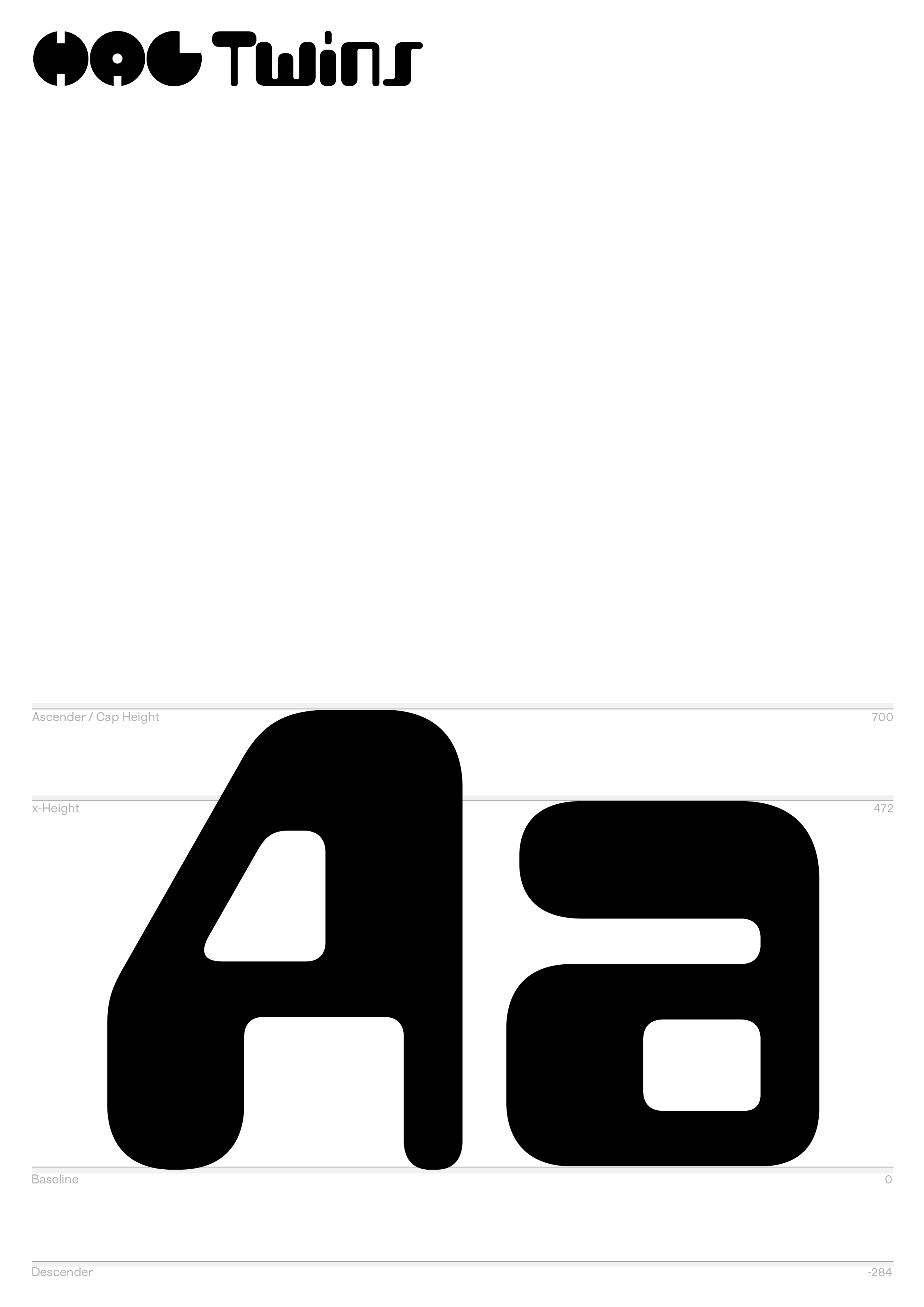
Typeface in use
PDF Specimen
Twins

In Use

“Visions” by Psychic Wines, Vol. 71 Design by James Anderson, 2024

Sign Up to the HAL Newsletter

Illustration